Introduction: when technical buyers no longer start with Google
In many technology-driven organizations, the first step in researching a solution no longer involves opening a traditional search engine. A systems architect in aerospace, a cybersecurity lead in a public agency, or an engineer working in power electronics may now start by asking a question directly to an AI assistant.
A query might look like this:
“What automated testing platforms for DO-254 electronic boards are best suited for aerospace environments, with integration to MATLAB and Jenkins?”
Within seconds, the assistant typically produces a structured synthesis. It may include:
- possible architectures
- key technical evaluation criteria
- a shortlist of vendors
- advantages and limitations of different approaches
The discovery process can therefore unfold without navigating across multiple web pages, downloading white papers, or even visiting a vendor’s website.

This shift is part of a broader transformation in how professionals search for information. Several studies suggest that roughly 40% of B2B buyers already use AI assistants to search for software or identify vendors. In technology sectors the share is even higher: nearly 80% of buyers report using generative AI as often as traditional search when exploring potential solutions.
For companies offering complex products in fields such as:
- aerospace
- defense
- cybersecurity
- power electronics
- industrial software
this evolution goes far beyond traditional SEO. It affects how suppliers are discovered, compared, and evaluated, often before any direct interaction with a sales team.
How technical buyers are actually using AI search
Rapid adoption among technical roles
AI assistants are spreading across the entire B2B landscape, but adoption is particularly strong among technical professionals. Engineers, systems architects, and security specialists are accustomed to working with complex digital tools and managing large amounts of information. AI assistants fit naturally into these workflows.
Recent studies show that:
- nearly two-thirds of B2B decision makers report using tools such as ChatGPT, Copilot, or Perplexity to research or evaluate vendors
- among professionals aged 25–34, adoption sometimes exceeds 80%
- in technology companies, AI is used at least as often as traditional search
These users are not peripheral to the purchasing process. They are often the people who:
- define system architectures
- draft RFIs and RFPs
- evaluate technical solutions
- shape the final shortlist of suppliers
The way they search for information therefore directly influences which vendors become visible early in the buying process.
Queries rich in technical context
The searches performed by these profiles differ significantly from typical marketing queries. Questions addressed to AI assistants usually include:
- precise technical constraints
- existing tools or infrastructure
- standards and regulatory requirements
- performance objectives
Examples might include:
“How should thermal simulation solutions for satellites be compared in terms of model accuracy, computation time, and integration with a specific CAD environment?”
or
“What SIEM architectures are recommended for a government ministry with data sovereignty requirements and legacy mainframe systems?”
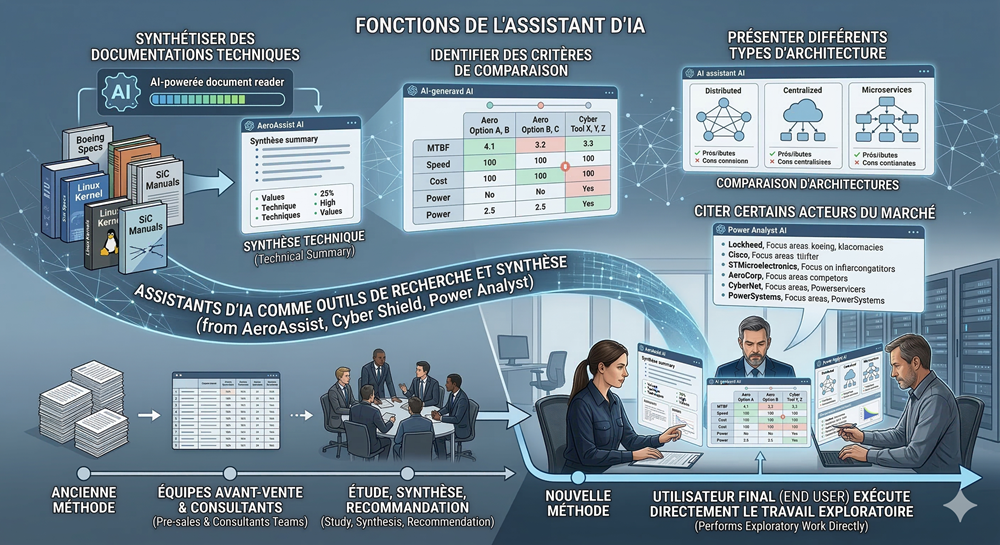
AI assistants can then:
- synthesize technical documentation
- identify comparison criteria
- describe alternative architectural approaches
- reference certain vendors in the market
Part of the exploratory work that was previously carried out by consultants or pre-sales teams is therefore increasingly performed directly by the end user.
AI appearing across the entire buying cycle
AI is not only used at the beginning of the process. In complex purchases, assistants can support multiple stages of decision-making.
Studies indicate that buyers are already using AI tools to:
- prepare RFI questionnaires
- analyze vendor responses
- compare architectures
- evaluate certain technical or security risks
In more advanced environments, AI may also help:
- generate comparison matrices
- summarize technical proposals
- detect inconsistencies in responses.
In sensitive sectors such as defense, critical infrastructure, or healthcare, this means that AI can indirectly influence how vendor offers are evaluated.
Specific effects on highly technical solutions
Compression of some stages in the buying journey
Traditional B2B marketing models assumed a multi-step buying journey. Buyers typically moved through phases such as:
- exploring the problem
- researching solutions
- reading educational content
- attending webinars
- interacting with experts
- building a shortlist.
AI assistants are reshaping part of this sequence. A well-structured query can generate a synthesized view of the market within seconds.
This does not eliminate human interaction, but it can shorten certain exploratory phases. Discussions with vendors often happen later in the process, once the buyer already has a structured understanding of the available approaches.
Amplification of expertise signals
In complex technical projects, perceived expertise remains a decisive factor. AI assistants tend to highlight companies that have a rich and credible body of publicly available technical material.
Content that tends to be particularly visible includes:
- detailed technical articles
- application notes
- scientific publications
- conference presentations
- documented case studies
- participation in industry standards
Conversely, a lack of technical content can become a disadvantage. If a company publishes little information about its architectures or methodologies, AI systems may struggle to identify it as a relevant actor in the market.
The visibility bias
AI-driven discovery introduces another phenomenon. Models rely heavily on publicly accessible information. Actors that are well represented in those information sources are therefore more likely to appear in AI-generated responses.
This can create situations where:
- a technically strong but discreet supplier is rarely mentioned
- a vendor that publishes extensively becomes more frequently cited
Visibility in AI-generated answers is therefore becoming a strategic dimension of market competition.
What this means for high-tech product marketing
Building an AI-readable technical corpus
AI assistants rely on publicly available information when generating answers. For technology companies, this creates a clear opportunity: structuring their expertise so that it can be understood and synthesized easily.
Useful formats include:
- detailed technical guides
- application notes
- technical FAQs
- methodological comparisons
- specialized glossaries
- architecture diagrams
A practical approach is to identify the key questions engineers and system architects typically ask, then produce structured technical notes that explain available options, evaluation criteria, and trade-offs.
The goal is no longer simply to write for a human reader browsing a website. It is also to produce content that AI systems can interpret and summarize accurately.
Providing your own comparison framework
Comparison is one of the stages most affected by AI. Assistants often generate tables or lists of criteria when presenting alternative solutions.
If vendors do not provide those frameworks themselves, the AI may construct them from heterogeneous sources. For that reason it can be useful to publish:
- decision checklists
- technical comparison grids
- evaluation guides
These materials can then become reference points that AI assistants use when structuring their responses.
Moving beyond traditional SEO
In this context, some experts refer to Answer Engine Optimization (AEO). The objective is no longer only to appear in search engine rankings, but to be mentioned in the answer generated by an AI assistant.

Achieving that requires:
- consistent messaging across product documentation, websites, and sales materials
- clear technical FAQs
- visibility in credible third-party sources, such as technical publications or analyst reports.
The strategic question becomes slightly different from the traditional SEO perspective. Instead of asking whether your company ranks well on Google, the question becomes whether your company is mentioned when an AI explains the market.
Particular dynamics in B2G and critical systems markets
Indirect influence on how tenders are prepared
In public procurement contexts, AI assistants are increasingly used to explore technological domains and identify best practices.
Some studies suggest that roughly 47% of B2B buyers already use AI tools for tasks related to market research or questionnaire preparation.
In government or institutional projects, these tools may help teams:
- identify relevant standards
- generate functional requirements
- structure evaluation criteria.
Public technical content produced by suppliers can therefore influence how procurement specifications are formulated, sometimes well before a formal tender process begins.
The importance of compliance signals
In critical markets, perceived supplier risk is a major factor in decision-making. AI assistants can easily aggregate publicly available information related to:
- certifications
- regulatory approvals
- compliance with standards
- customer references
Documenting these elements clearly becomes essential if companies want them to appear correctly in AI-generated syntheses.
Practical actions for product and marketing leaders
Organizations can approach this transformation in a structured way.
Some practical steps include:
Identify the key questions in your market
- What technical questions do engineers and architects actually ask?
- Which criteria do they use when comparing solutions?
Structure a technical knowledge base
- architecture guides
- application notes
- technical comparisons
- specialized FAQs.
Observe how AI systems describe your market
- test representative queries regularly
- analyze which vendors appear in the answers
- identify which messages or claims are repeated.
These observations can help refine both content strategy and the way technical expertise is published.
Conclusion: a gradual shift in how vendors are discovered
In highly technical B2B and B2G markets, AI assistants are becoming a new layer between suppliers and potential customers. Engineers, architects, and procurement specialists increasingly rely on these tools to explore technological domains, compare solutions, and prepare decisions.
For technology companies, the challenge is no longer limited to appearing in traditional search results. It also involves ensuring that their architectures, expertise, and references are clearly represented in the information sources that AI systems use to build their understanding of a market.
Testing how AI assistants respond to representative technical questions can provide a useful signal. If your company does not appear when those questions are asked, it may indicate that your expertise is still underrepresented in the information ecosystem that these systems rely on to explain a sector and compare its solutions.
