
How Extreme Engineering Has Transformed Our Healthcare System
2030. A patient is admitted for complex cardiac surgery. Before the first incision, their digital twin has already undergone the procedure ten times in the cloud, optimizing every surgical move. The assisting robot—whose force sensors originate from a Mars rover program—compensates for the heart’s micro-movements in real time. The monitoring AI, derived from airborne threat detection systems, predicts a complication ten minutes before it occurs. In this operating room, the boundary between civilian and military has disappeared. Technology has become purely vital.
This scenario is not science fiction. It is the logical conclusion of decades of technology transfer from the most hostile environments humanity has conquered: the battlefield, deep space, and critical infrastructure.
Modern medicine, as we practice it today, is no longer a purely biological discipline. It has become a high-reliability engineering field. What the general public perceives as “high-tech medicine”—advanced imaging, surgical robots, telemedicine, cutting-edge prosthetics—is in reality the direct legacy of defense and aerospace programs.

The purpose of this article is to go beyond historical anecdotes and analyze the deeper mechanics of this technological transfer: how have tools designed to destroy, or to survive in the vacuum of space, become pillars of our civilian healthcare system? And what issues of sovereignty and ethics arise from this growing dependence?
The Mechanics of Transfer: Why the Extreme Is the Best Laboratory
To understand why defense and space are engines of medical innovation, one must analyze their design constraints. A NASA engineer or an engineer at a major defense contractor does not design a product for a mass market; they design a solution for a critical mission where failure is not an option.
99.99% Reliability: The Legacy of Aerospace
In civilian industries, a software bug is an inconvenience. In a fighter jet or a space station, it is a catastrophe. This culture of absolute reliability has gradually been transferred to the medical sector. Life-support devices, infusion pumps, and vital-sign monitors now rely on redundant architectures and testing protocols directly derived from the nuclear and aerospace industries—sectors where tolerance for error is structurally zero.
Miniaturization and Autonomy: The Challenge of Space
Space is the most constrained environment in terms of mass and energy. Every gram sent into orbit costs thousands of dollars. This constraint has driven extreme sensor miniaturization and radical optimization of energy consumption. These advances now lie at the core of implantable medical devices—pacemakers and insulin pumps—as well as wearable sensors that monitor chronic patients at home at an accessible cost.
Trauma and Emergency Medicine: The Battlefield as a Laboratory
If there is one field where technological transfer is direct and unmistakable, it is emergency medicine. Modern traumatology is the direct descendant of battlefield medicine—an uncomfortable but historically undeniable truth.
The “Golden Hour” and Triage
The concept of the Golden Hour—the critical hour after trauma during which survival chances are highest—was theorized and refined on military operational theaters. Triage protocols, the organization of care pathways, and modular field hospitals are military innovations that now structure civilian emergency services and disaster-response systems.
Helicopter Medical Evacuation
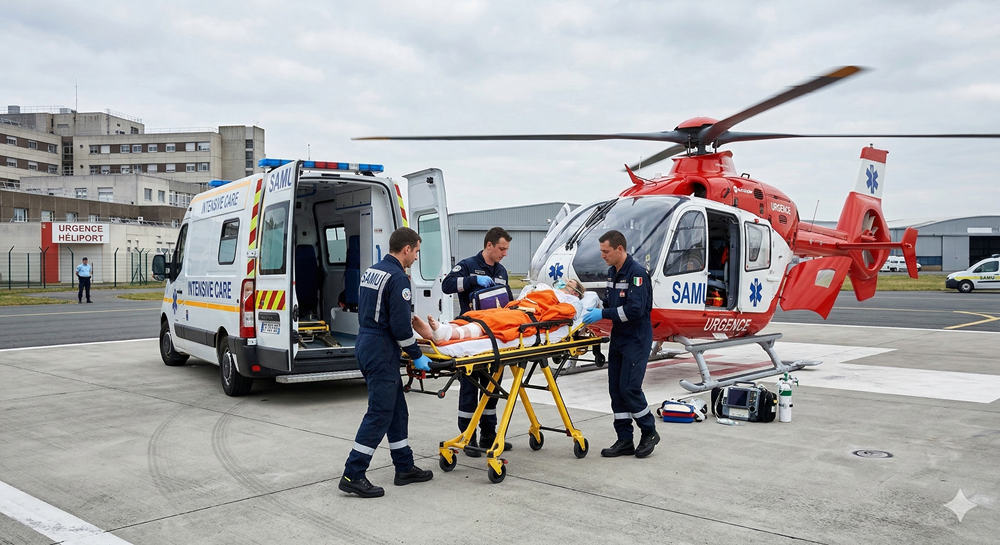
The systematic use of helicopters to transport critically injured patients to specialized centers became widespread during the Korean and Vietnam wars. Today, emergency medical services and helicopter rescue units save thousands of lives each year by applying logistical and medical procedures originally designed to extract soldiers under enemy fire.
The Auto-Injector: From Battlefield Antidote to the EpiPen
One of the most striking examples of dual-use technology remains the epinephrine auto-injector. Initially developed to allow soldiers to self-administer antidotes in the event of a chemical attack, this device was later adapted to treat severe anaphylaxis. It has empowered millions of allergy patients, transforming a complex medical procedure into a reflex action accessible to anyone.
Medical Imaging and Surgical Robotics: The Legacy of the Stars
Modern medical imaging owes a considerable share of its progress to astronomy and satellite observation. These two disciplines, seemingly unrelated, share a common obsession: capturing extremely faint signals in noisy environments.
From the Hubble Telescope’s CCD Sensors to Digital Mammography
The CCD (Charge-Coupled Device) sensors developed for the Hubble Space Telescope—designed to capture the faint light of distant galaxies—were later adapted for digital mammography. Today, this technology allows the detection of breast tumors with higher resolution and significantly lower radiation exposure than conventional techniques. A direct transfer from astronomy to oncology.
Surgical Robotics: When NASA Imagined the Remote Scalpel
The Da Vinci surgical robot, a global leader in assisted surgery, traces its origins to research conducted by NASA and DARPA on teleoperation. The initial goal was to enable a surgeon on Earth to operate on an astronaut in orbit or a soldier on a distant battlefield. While true telesurgery remains complex due to latency constraints, the precision of articulated robotic arms and high-definition 3D vision has revolutionized civilian operating rooms—allowing less invasive procedures and faster recovery for patients.
Artificial Intelligence and Digital Twins: The New Dual Frontier
We are now witnessing a shift in the nature of technological transfer. It is no longer purely hardware—it has become software-driven. This is a profound transformation that is redefining the possibilities of precision medicine.
Diagnostic AI: From Military Target Recognition to Oncology
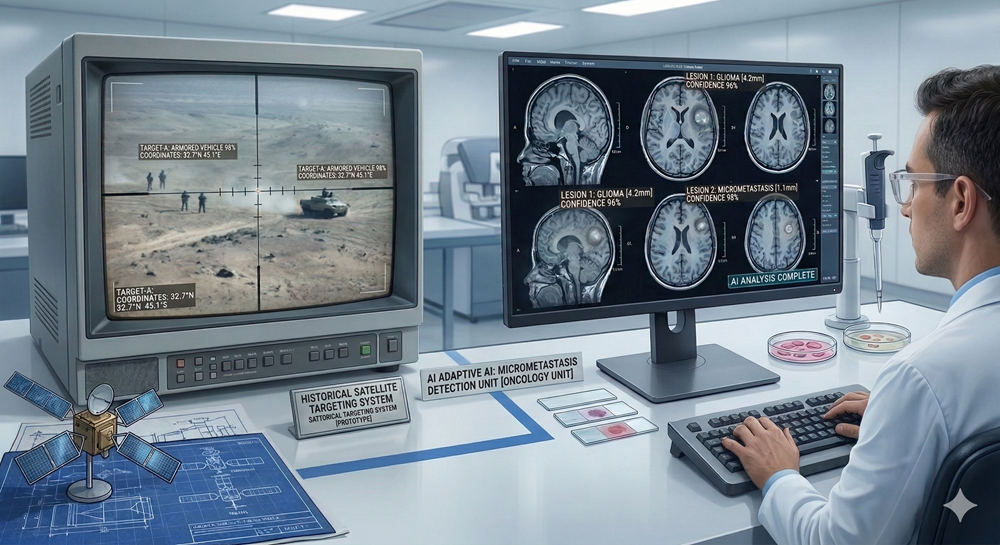
Image-recognition algorithms originally developed for military satellites—capable of identifying ground targets from aerial imagery—are now being applied to the analysis of MRI and CT scans. These AI systems detect microscopic cancer lesions invisible to the human eye, with a level of precision inherited from decades of defense research in signal processing.
Digital Twins: The Patient as a Complex System
The concept of the digital twin was born in aerospace engineering to simulate the real-time behavior of an aircraft engine in order to anticipate failures before they occur. Applied to medicine, it enables the creation of a complete digital model of a patient or an organ. In oncology as in cardiology, physicians can now simulate the impact of a treatment or surgery on the digital twin before intervening on the real patient. This represents the shift from statistical medicine to a form of absolute precision medicine.
Systemic Benefits: Toward a High-Reliability Culture in Healthcare
The contribution of dual-use technologies goes beyond isolated tools. It transforms the very culture of the healthcare system by introducing risk management methods proven in sectors where error is not permitted.
Safety Standards and Operating Room Checklists
The healthcare industry has progressively adopted safety and risk-management standards derived from aviation and nuclear sectors. The operating room checklist—now recommended by the World Health Organization—is a direct legacy of aviation cockpit procedures. This safety culture raises the overall quality of care and reduces preventable medical errors, whose human and economic costs remain considerable.
Telemedicine: From Isolated Space Missions to Civilian Medical Deserts
Telemedicine was tested very early in military and space contexts to ensure continuity of care in areas without direct access to a physician. It has since become a pillar of healthcare access in civilian medical deserts. The teleconsultation and remote monitoring platforms used today rely on secure communication protocols originally developed for defense.
Ethical and Strategic Challenges: The Other Side of the Coin
This growing dependence on dual-use technologies raises fundamental questions that political, industrial, and medical decision-makers can no longer avoid.
The Dual-Use Paradox: The Weapon and the Cure
A technology capable of saving lives can also be diverted to take them. Advances in genomics, nanotechnology, and health AI are intrinsically dual-use. An algorithm capable of predicting the structure of a protein to design a medicine can also be used to model a pathogen. This paradox requires governance frameworks and export control mechanisms of extreme rigor—requirements that our institutions still struggle to maintain at the pace of innovation.

Health Sovereignty and Technological Dependence
If the critical building blocks of our healthcare system—sensors, AI algorithms, surgical robotics—come from value chains controlled by foreign powers through extraterritorial legislation (notably ITAR/EAR in the United States), our health sovereignty is structurally vulnerable. In the event of major geopolitical tensions, access to spare parts or software updates for vital hospital equipment could be compromised—with direct consequences for the care capabilities of an entire country.
Conclusion: Healthcare as a New Critical Infrastructure
The contribution of dual-use technologies to medicine is immense and transformative. But it forces us to fundamentally rethink our vision of the healthcare system. Healthcare is no longer merely a public service; it is a critical infrastructure built on a technological foundation shared with defense and aerospace.
The question that then arises: can we still claim to achieve cutting-edge medical innovation without a clear and coherent dual industrial strategy?
If we want a healthcare system that is highly reliable, accessible, and sovereign, we must acknowledge this organic link between extreme environments and the patient’s bedside. The medical innovations of tomorrow will not emerge solely from biology laboratories. They will arise at the intersection of extreme engineering and the life sciences.
